

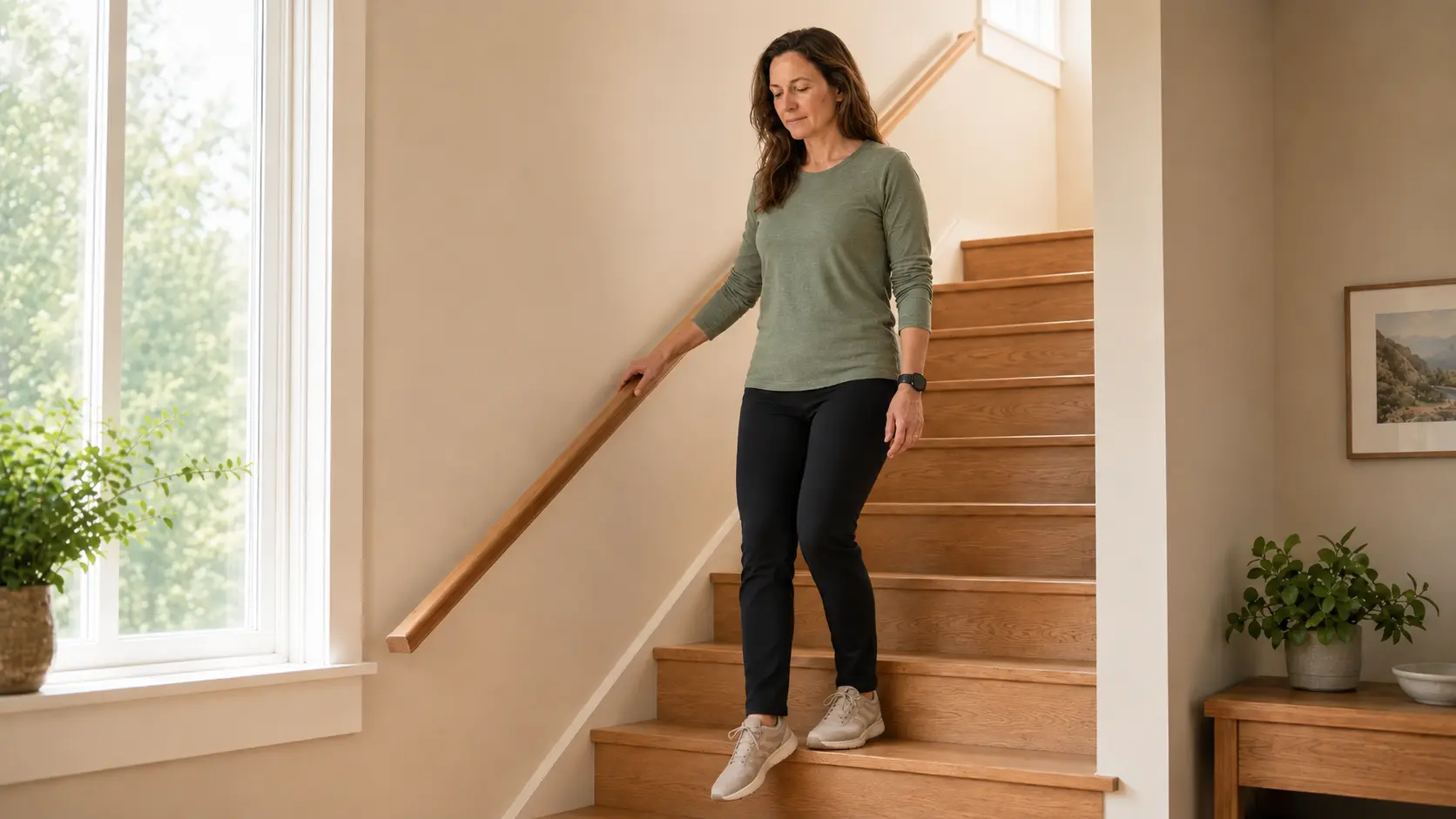
Climbing a staircase never bothered me. Coming back down was a different story, a sharp twinge on every single step. My physical therapist wasn't surprised at all: “Going down is the harder job for your knee, not the easier one.”
That one sentence changed how I thought about it completely. Here's the mechanics behind why descending hurts more, then the exact technique that reduced my pain that same day.
What this guide gives you
- ✓Why descending loads the knee more than climbing
- ✓A descent technique that reduces load immediately
- ✓4 exercises that build the strength stairs demand
Research published in the Journal of Orthopaedic Research has measured knee joint forces during stair descent at meaningfully higher than during ascent, with the quad muscles working eccentrically the entire way down to control your landing.
Why Going Down Hurts More Than Going Up
Climbing is your quad pushing you upward, a concentric contraction your muscle is built well for. Descending is your quad slowly lowering your full body weight one step at a time, an eccentric contraction that puts far more compressive force through the kneecap joint.
The 3 Structures That Take the Load
The kneecap joint (patellofemoral), which absorbs the bulk of the compressive force. The quad tendon, working eccentrically the whole way down. The cartilage under the kneecap, which is exactly where most stair-related pain is actually felt.
The Descent Technique That Reduces Load Immediately
Slow your pace and land on a slightly bent knee, never a locked one. Lightly use the rail, not to hang your weight on it, but to take a small percentage of load off the joint on each step. Lead with your stronger leg if one knee is worse, so it absorbs the first landing.
4 Exercises That Prepare You for Stairs
These build exactly the eccentric quad strength stairs demand. For a broader routine, see knee-strengthening exercises after 50.
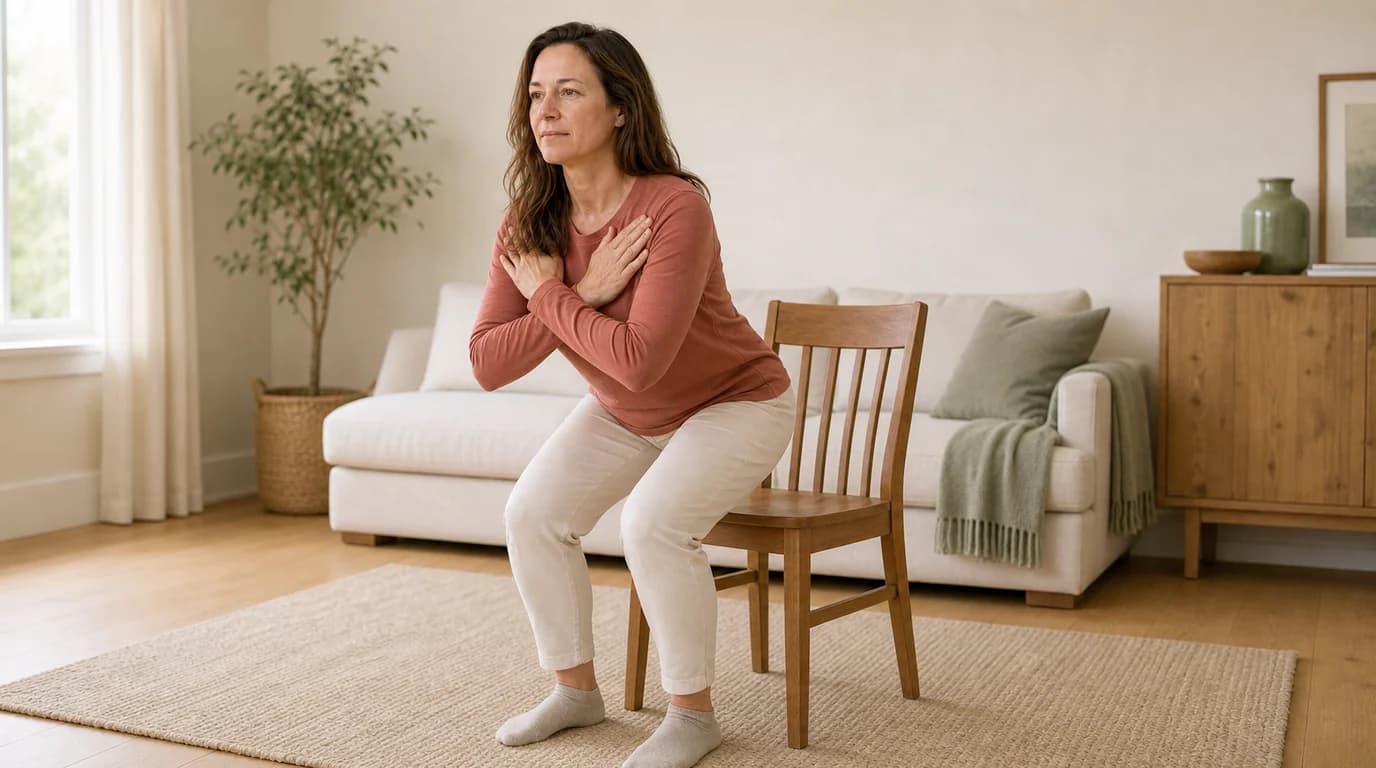
🪑 Sit-to-stands
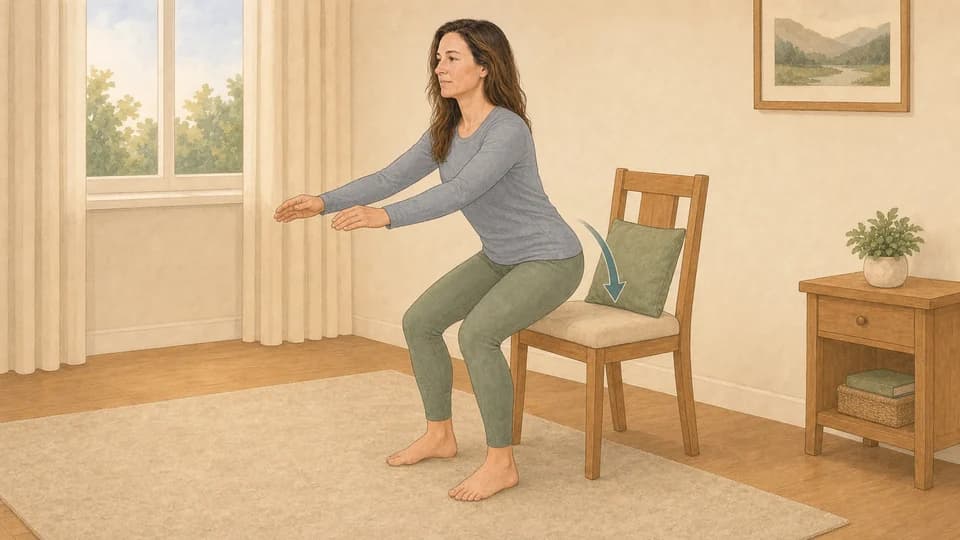
Why: Directly trains the eccentric quad control you use on every step down.
How: From a chair, stand up, then lower back down slowly over a count of 4. 10 reps.
🦵 Seated knee extensions
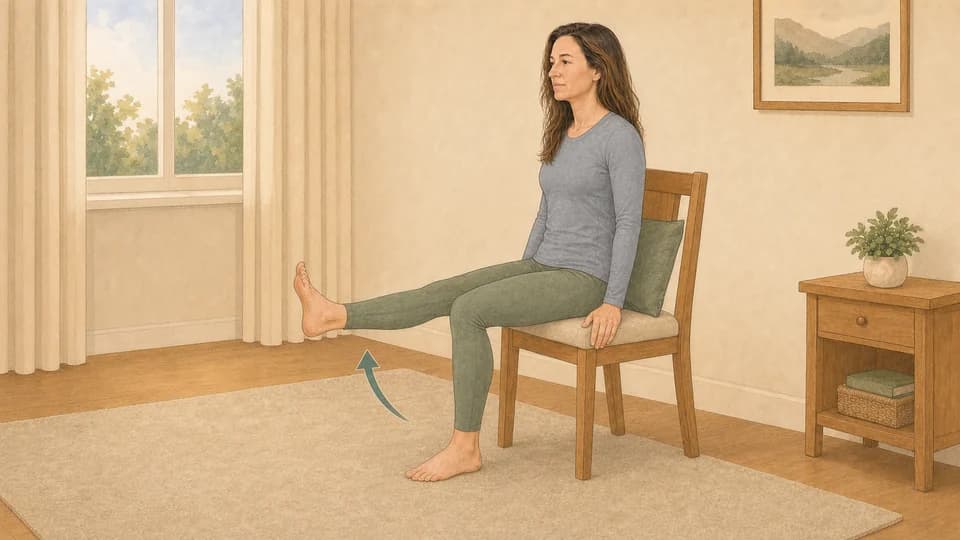
Why: Builds raw quad strength without any impact on the joint.
How: Sit on a chair, straighten one leg slowly, hold 2 seconds, lower with control. 12 reps per leg.
🩰 Step-downs on a low step
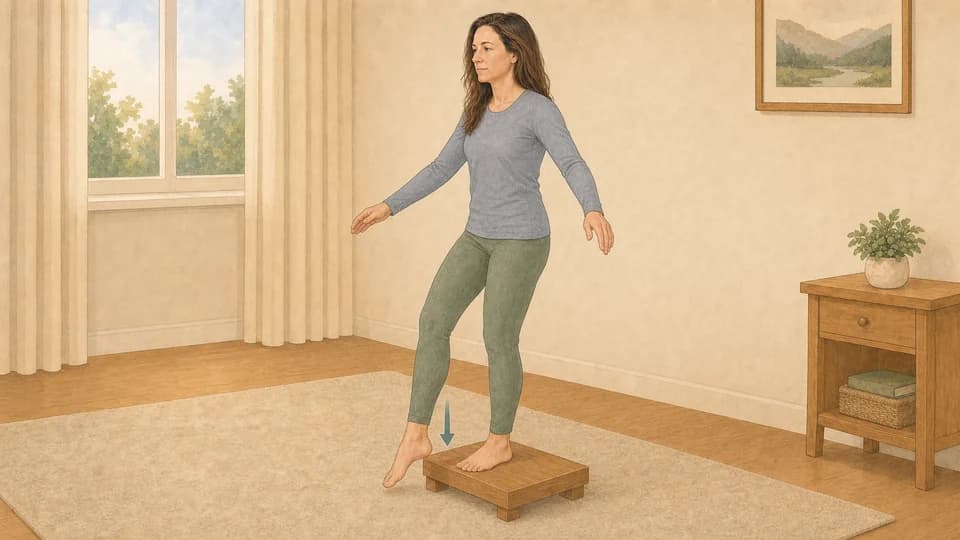
Why: Rehearses the exact movement pattern of a stair descent, at low intensity.
How: Stand on a low step or thick book, lower your other foot to just tap the floor, then push back up. 8 reps per leg.
🍑 Wall sits
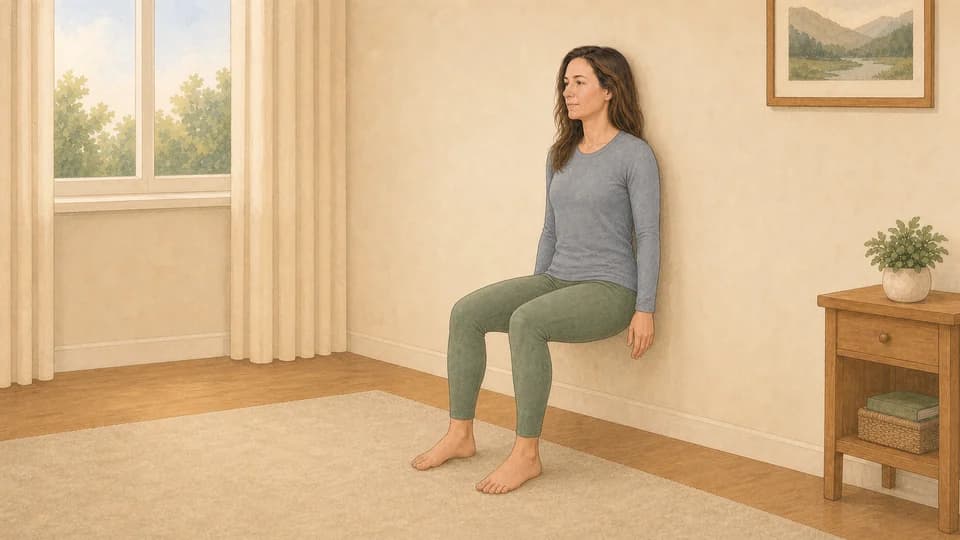
Why: Builds the endurance strength that keeps your knee steady on a long staircase.
How: Back against a wall, knees bent to a comfortable angle, hold for 20 to 30 seconds.
Shoes and Stairs: What Actually Matters
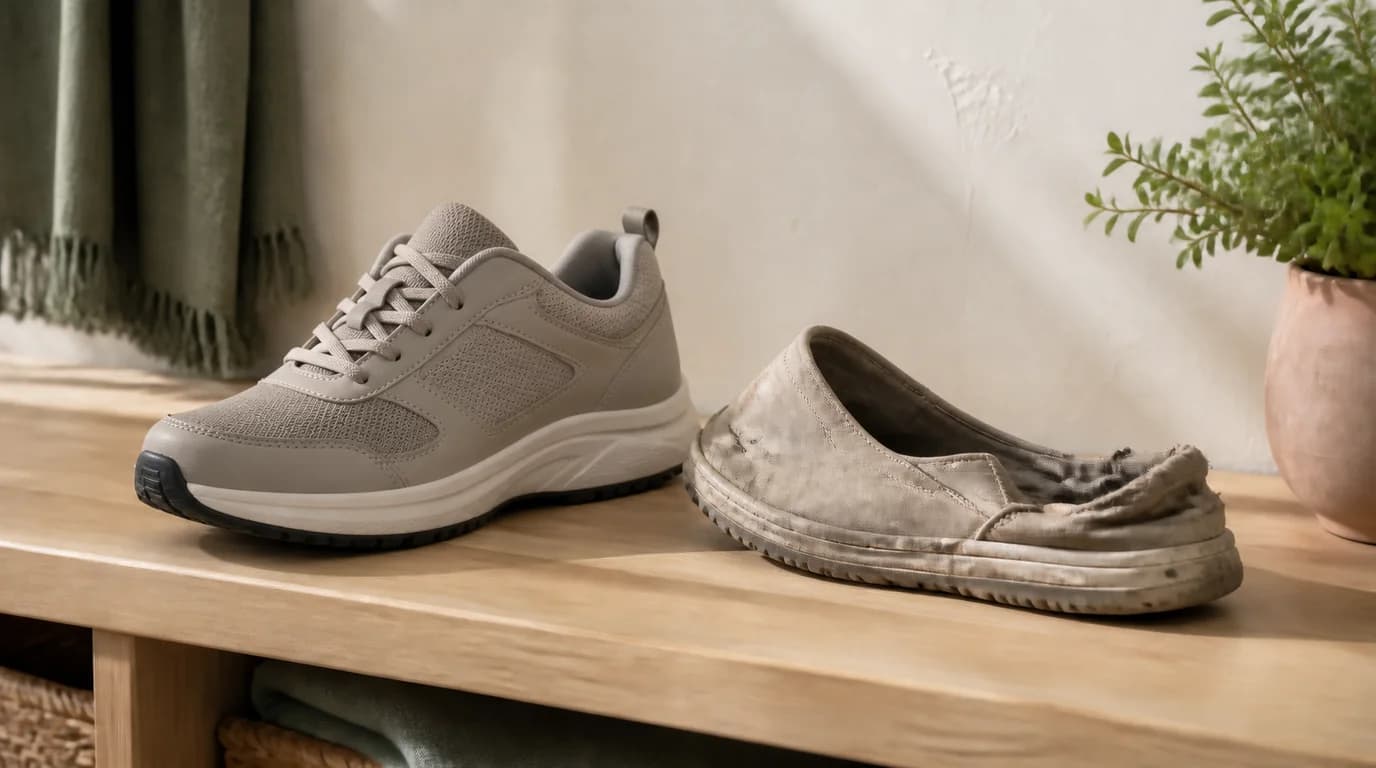
A stable, cushioned sole matters more than any specific brand. Worn-out soles or thin flats give your knee less shock absorption on every landing. If your walking form is also off, that shows up on stairs too. My 3-minute walking form fix carries over directly to how you land on each step.
The Sign That's Worth a Doctor's Visit
Occasional twinges on stairs are common. A knee that gives way, swells noticeably, or hurts on flat ground too is a different situation, and worth a real evaluation rather than more exercises. Sometimes it's not even the knee itself: see is your hip secretly causing your knee pain.
Not sure whether it's your knee, your hip, or your walking pattern?
Find your joint fix. Free 60-sec quiz →Get the free Anti-Inflammatory Grocery List
Strength protects your knees on stairs. Food calms inflammation from the inside. Get the free 1-page grocery list, organized by aisle. No spam, unsubscribe anytime.
The Bottom Line
Going down is genuinely harder on the knee than going up, so twinges on the way down aren't a sign of weakness on your part. Slow your pace, use the rail lightly, and build the eccentric quad strength that makes each step easier over time.
What's really behind YOUR knee pain?
Take the free 60-second quiz for a personalized starting point.
Take the free joint quiz →Free · No email required · Results in 60 seconds
Keep reading

Medical disclaimer: This is my personal experience, not medical advice. Talk to a qualified professional before starting a new exercise routine, especially with a diagnosed knee condition, swelling, or a recent injury.