

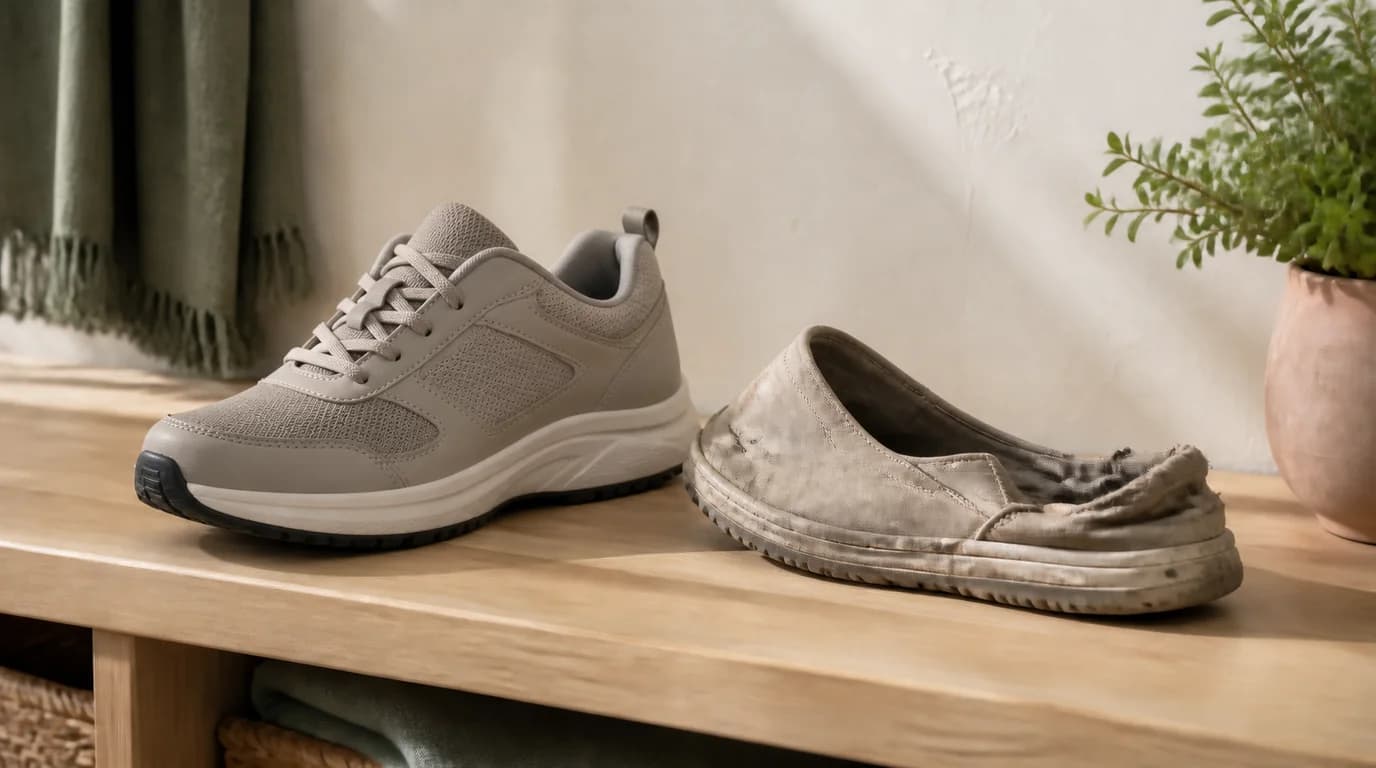
I brought my favorite walking shoes to physical therapy expecting a gold star. My PT turned them over, pressed the heel and said, “These retired about 300 miles ago. You just kept inviting them to work.”
The foam leaned inward and the heel folded like a slipper. I replaced them with a stable, comfortable pair and my after-walk ache stopped lingering all evening. I now ignore the logo and run every shoe through six simple checks.
The shoe test, not a shopping list
- ✓Three features that usually feel kinder to sore knees
- ✓Three common shoe mistakes worth leaving on the shelf
- ✓A 60-second fit test you can do before buying
In a 2021 Annals of Internal Medicine trial of 164 people with medial knee osteoarthritis, stable supportive shoes improved walking pain by 1.1 points more on a 10-point scale than flat flexible shoes after six months. The best shoe is still the one that fits your foot and symptoms.
The 6 Shoe Features I Check
The first three are usually helpful. The last three are reasons to pause.
✅ Best: a heel that holds its shape
Why: A firm heel counter keeps the back of the foot from sliding and wobbling, which can make the knee work harder to control every step.
How: Pinch the back of the shoe. It should give a little but should not collapse flat between two fingers. Your heel should stay seated when you walk.
✅ Best: cushioning without the wobble
Why: Some cushioning can make pavement more comfortable, but a very tall marshmallow-soft sole may feel unstable if your knees or balance are already uncertain.
How: Walk, turn and stop quickly in the store. Choose the pair that feels quiet and predictable underfoot, not simply the softest pair on first squeeze.
✅ Best: room up front, security in the middle
Why: Cramped toes change how you push off, while a loose midfoot lets the foot slide inside the shoe. Both can alter the path of your knee.
How: Leave roughly a thumb width ahead of your longest toe. Lace the middle securely, then confirm that no toe is rubbing or being pushed inward.
❌ Worst: a sole worn down on one edge
Why: A favorite shoe can look fine from above while its compressed foam quietly tips each landing to one side.
How: Set both shoes on a table at eye level. If either shoe leans, rocks or has a deeply smooth tread patch, retire it from long walks.
❌ Worst: high, narrow or backless for distance
Why: A high heel shifts load forward, a narrow toe box crowds the foot, and a backless shoe makes you grip to keep it on. That is a lot of compensation for one walk.
How: Save fashion-first pairs for short, predictable outings. For exercise or errands, choose a lower stable base, secure heel and grippy sole.
⚠️ Worst: changing everything overnight
Why: Even a well-designed shoe can irritate your feet, calves or knees if its shape and heel height are very different from what your body knows.
How: Break a new pair in with 15 to 20 minutes at home, then a short walk. Increase gradually and stop if pain keeps building rather than settling.
Here is my final test: I walk fast, turn, climb a few steps and stand on one leg near a wall. The shoe should disappear under me. If I am already fighting it in the store, my knees will not negotiate better outdoors.
Fit advice is not a diagnosis
See a clinician, physical therapist or podiatrist for sudden swelling, inability to bear weight, numbness, a recent twist or fall, repeated giving way, or pain that keeps worsening despite changing shoes.
Shoes can reduce one source of irritation, but they cannot tell you why your knee hurts.
Find your joint fix. Free 60-sec quiz →Your walks start in the grocery aisle too
Get the free 1-page Anti-Inflammatory Grocery List for easy joint-friendly meals between walks. Organized by aisle, no spam.
The Bottom Line
Buy for your foot, not for the loudest claim on the box. Look for a stable heel, comfortable cushioning, enough toe room and a secure fit. Check the soles you already own tonight. Sometimes the worst shoe is the pair that used to be perfect and quietly stopped doing its job.
Is footwear the whole story behind your knee pain?
Take the free 60-second quiz to sort movement, stiffness and inflammation clues.
Take the free joint quiz →Free · No email required · Results in 60 seconds
Keep reading



Medical disclaimer: This is my personal experience, not medical advice. Talk to a qualified professional before changing footwear or activity when pain is persistent, severe or linked to an injury.