

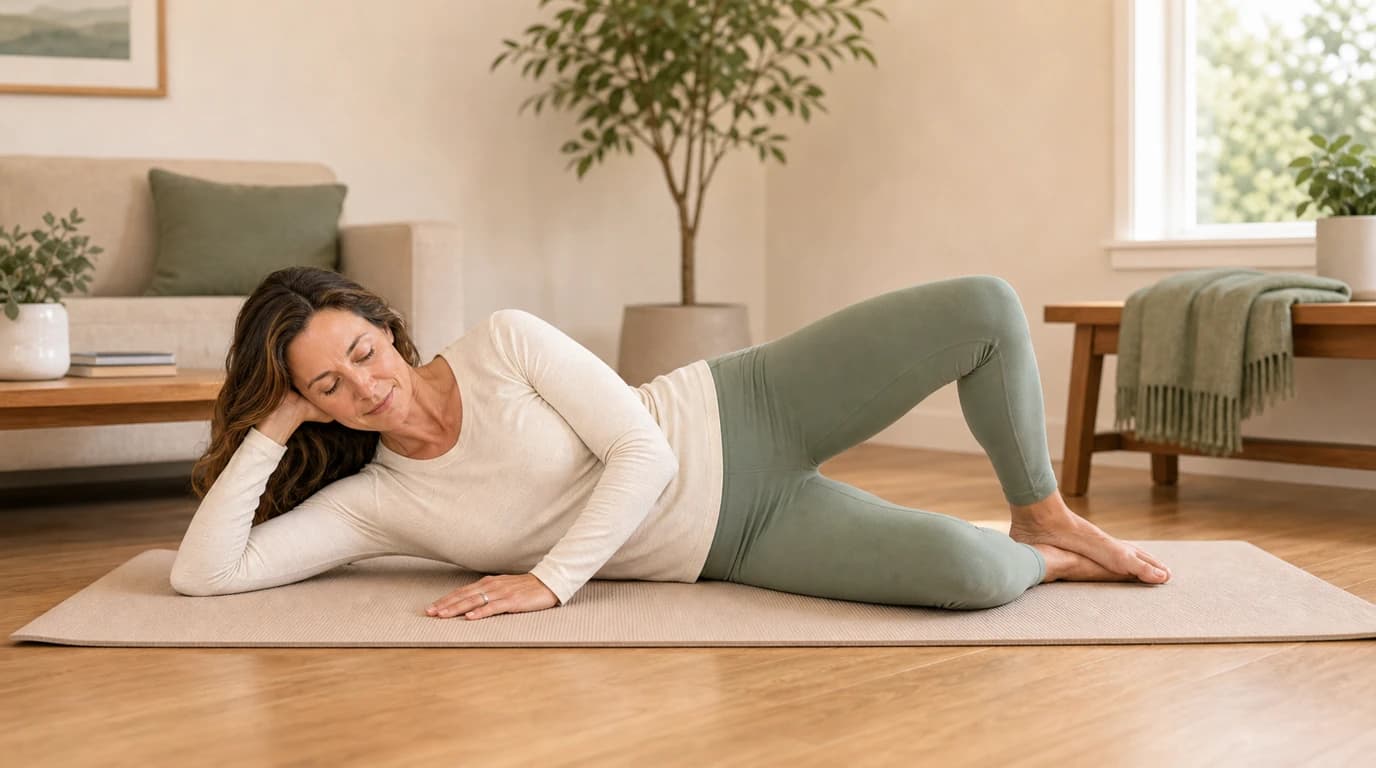
For six months I stretched my knee like it was the problem. Quad stretches, foam rolling, ice after walks. It would ease for a day, then come right back. I finally booked a physio visit and she barely looked at the knee. She watched me climb 3 stairs, then said one sentence that reframed everything.
"Your knee is the loudest one, but your hip is the one making it loud." She showed me the kinetic chain: hip weak, thigh collapses inward, knee tracks off-center, knee complains. Fix the hip and the knee shuts up. Here are the 4 clearest signs your knee pain is actually a hip problem, and one targeted fix per sign.
What you'll learn:
- ✓The 4 clearest signs your hip is the real source of your knee pain
- ✓A 20-second self-test for each sign, no equipment
- ✓One targeted hip fix per sign that quiets the knee within 2 weeks
In studies of women over 40 with anterior knee pain, adding hip-strengthening exercises reduced pain more than knee exercises alone. The rehab principle is simple: the knee is a hinge between two ball-and-socket joints (hip and ankle), and a hinge only tracks well when both ends of the chain are stable.
The 4 Signs (With a Self-Test for Each)
Read each sign, do the quick cue test, and note which ones match you. Most people match 2 to 3.
⬆️ Your Knee Caves Inward Going Up Stairs
Self-test: Film yourself climbing 3 stairs from the front. Watch the working knee: does it drift toward the other knee as you push up?
Why: The glute medius, the muscle on the outside of your hip, is supposed to keep the femur from rotating inward. When it's weak (extremely common after 50 and after any period of sitting), the hip lets the thigh collapse in, and the kneecap tracks off-center. That grinding is the pain.
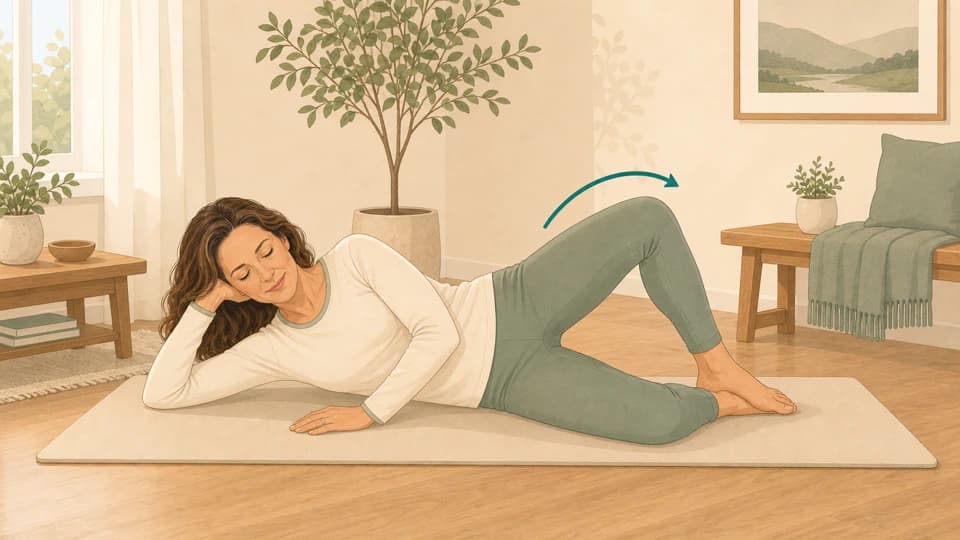
Fix: Side-lying clamshells: lie on your side, knees bent 45 degrees, heels together. Open the top knee like a clamshell without rocking the pelvis. 2 sets of 12 per side, every other day. Two weeks and the stair pain usually softens.
1️⃣ Only One Knee Hurts (The Same One, Always)
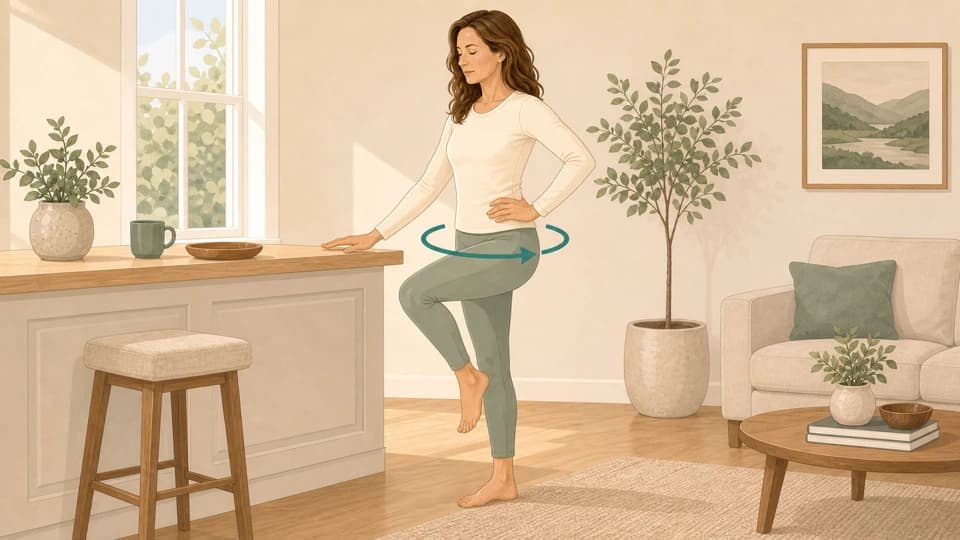
Self-test: Stand on one leg with your eyes closed for 20 seconds. Try both sides. Big difference in how wobbly you feel?
Why: One-sided knee pain almost always means one-sided hip weakness above it. The weaker hip lets the whole leg wobble under load. The knee is the joint that pays the bill because it's in the middle of the chain, taking the twist.
Fix: Single-leg balance work. Stand on the weaker leg, hand near the counter for support, and hold for 30 seconds. Progress to eyes closed. 3 rounds, twice a day. This rebuilds the hip stabilizers faster than any knee exercise.
🌀 Your Knee Tracks Inward When You Squat
Self-test: Squat 6 inches down while looking in a mirror. Do your knees drift toward each other?
Why: When you squat, your hips are supposed to rotate the thighs slightly outward to keep the knees stacked over the feet. If the deep hip rotators are underused, the knees fold in instead. Every squat, every step down, every sit-to-stand loads that inward twist.
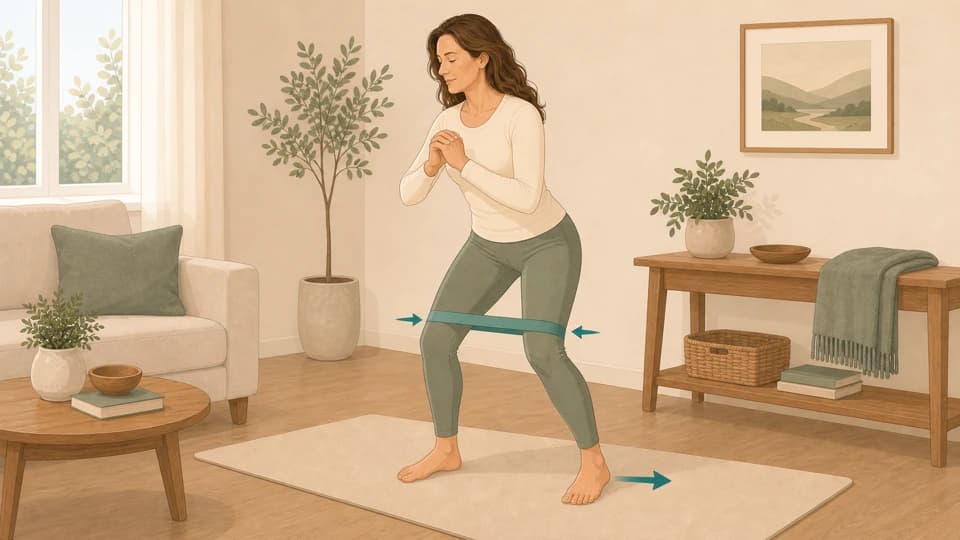
Fix: Monster walks with a mini-band around the knees. 10 slow steps forward, 10 back, 2 rounds. Or, if you don't have a band: standing side-leg lifts, 12 per side, twice a day. Wakes the external rotators back up in about a week.
🚶 Knee Pain After Long Walks
Self-test: Have someone film you walking away from them for 30 seconds. Does one hip drop each time that foot lands?
Why: This is called a Trendelenburg pattern. When the standing-leg hip drops, the pelvis tilts, and every step sends a small twist into the knee. Ten thousand steps a day of that twist and the knee starts complaining. The knee is fine. The hip stabilizer is not.
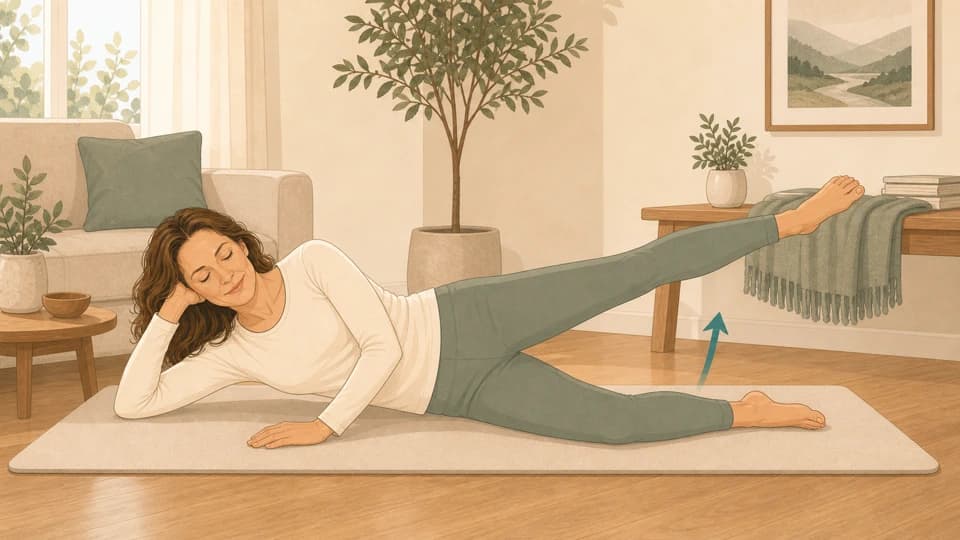
Fix: Side-lying leg raises: lie on your side, keep the top leg straight, and lift it about 12 inches with the foot slightly turned down (not up). Focus on the outer-hip work, not the thigh. 2 sets of 15 per side, every other day.
Which of the 4 signs matches you most? Take the 60-second quiz for a starting plan.
Find your joint fix: free 60-sec quiz →Strong hips, quieter knees, calmer joints
Hip strength handles the mechanics. Anti-inflammatory food handles the chemistry. Get the free 1-page Anti-Inflammatory Grocery List (PDF), joint-friendly foods organized by aisle. No spam, unsubscribe anytime.
The Bottom Line
A knee that keeps hurting after 50 is very often a hip that stopped stabilizing. Do the 20-second self-tests, note which signs match yours, and pick the fix (or two) that lines up. Give it 2 weeks of consistent work. Most knees get noticeably quieter once the hip above them starts doing its actual job.
Want a plan matched to your hip-knee pattern?
Take the 60-second quiz to find where to start.
Take the free joint quiz →Free · No email required · Results in 60 seconds
Keep reading
Medical disclaimer: This is my personal experience, not medical advice. Stop any move that causes sharp or worsening pain, and check persistent knee pain with a qualified professional before starting a new routine.