

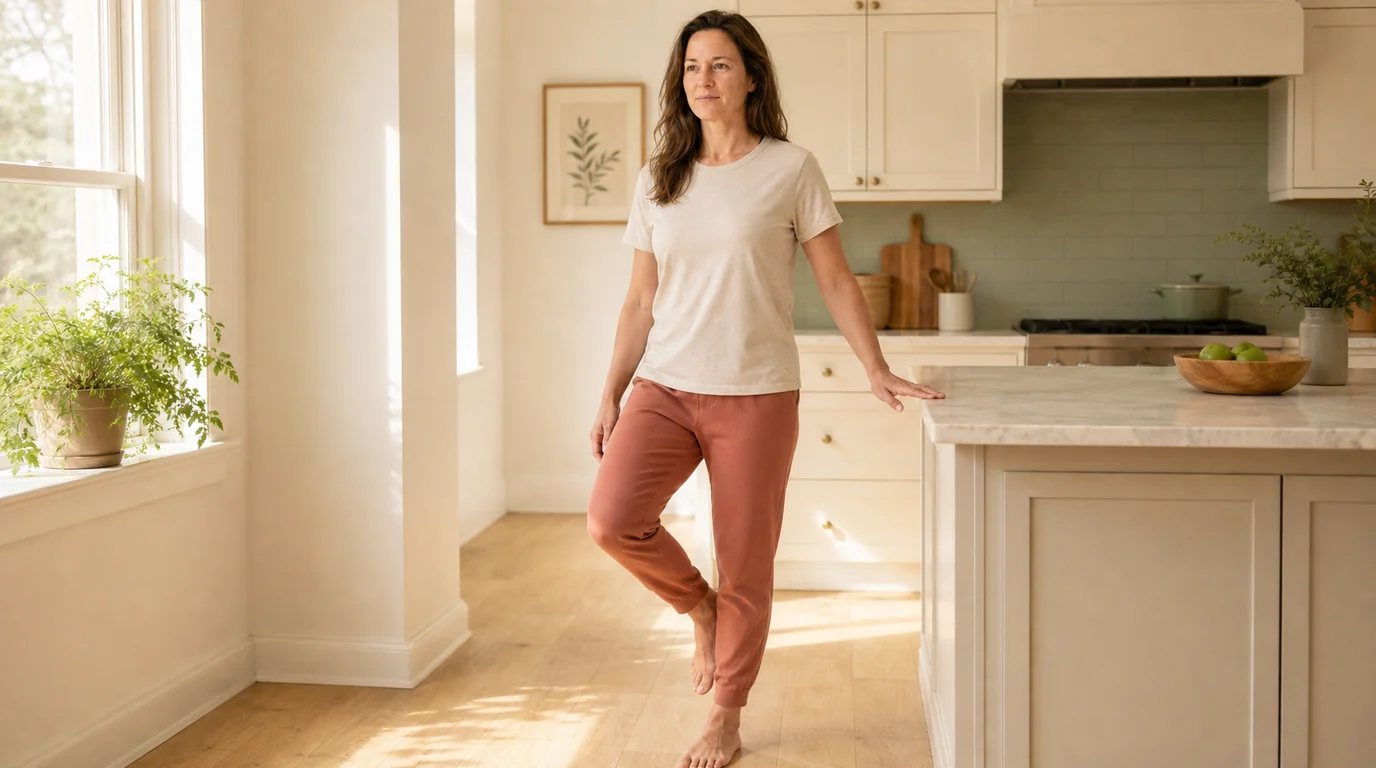
I went in talking about my knees. My physical therapist watched me walk the length of the corridor, then said, “Your ankles are barely moving. Everything above them is covering for that.” I had spent months looking two joints too high.
Ankles get stiff quietly. There is rarely a dramatic moment, just a slow loss of the range that lets you walk downhill, catch a stumble or feel steady on a gravel path. This is the five-move routine I now do barefoot next to the kitchen counter, and it takes about six minutes.
Six minutes, barefoot, no equipment
- ✓Why stiff ankles show up as a balance problem
- ✓Five moves in a sensible order, with clear repetitions
- ✓How to use a counter for confidence without leaning on it
A 2022 study in the British Journal of Sports Medicine followed adults aged 51 to 75 and found that being unable to hold a 10-second one-legged stand was associated with a higher risk of death during the follow-up period. Balance is not the cause of that, but it is a surprisingly honest marker of how well the whole system is working.
The 5-Move Ankle and Balance Routine
Do it barefoot beside a counter. The counter is there for confidence, not for leaning on.
🧦 Seated ankle circles and pumps
Why: The ankle has been still all night or all afternoon. Starting seated lets you find the available range without also managing your balance.
How: Sit tall, lift one foot slightly and draw ten slow circles each way, then point and flex ten times. Keep the movement at the ankle rather than swinging the whole leg. Repeat on the other side.
🧱 Wall ankle rock
Why: Bending the ankle forward over the foot is the motion walking downhill and going down stairs need most. When it is limited, the knee and hip quietly take the difference.
How: Stand facing a wall with your toes about a hand-width away. Keeping the heel flat on the floor, drive your knee forward towards the wall, then return. Ten slow repetitions per side, and note if one side stops much earlier.
⬆️ Calf raises with fingertip support
Why: The calf is the muscle that pushes you off at every step and helps steady you when you wobble. Range without strength does not hold up over a long walk.
How: Rest your fingertips on the counter, rise slowly onto the balls of both feet, pause for one second at the top and lower under control over three seconds. Start with eight to ten, and stop before the calf starts cramping.
🕊️ Single-leg stand
Why: Standing on one leg is what your body actually does between steps. It trains the small constant corrections at the ankle that keep a stumble from becoming a fall.
How: Hover your fingertips over the counter without touching it, lift one foot a few inches and hold for up to twenty seconds. Look at a fixed point ahead. Do two attempts per side, and touch down whenever you need to rather than fighting for a few extra seconds.
👣 Heel-to-toe walk
Why: Balance while moving is a different skill from balance standing still, and it is the one that matters on a narrow path or a dark hallway.
How: Walk ten steps along the counter placing the heel of one foot directly in front of the toes of the other. Keep your eyes forward rather than on your feet, and let your hand hover near the counter. Turn around and walk back.
The change that made this stick was doing it barefoot while the kettle boiled, rather than treating it as exercise that needed a slot in the day. Two things told me it was working before any of the moves felt easier: walking downhill stopped feeling like braking, and I stopped watching my feet on uneven ground. If one ankle is clearly stiffer than the other, that asymmetry is worth mentioning to a professional.
Work within a safe setup
Always have a solid surface within reach for the balance moves, and do not attempt them alone if you have fallen recently or feel unsteady on your feet. Stop for sharp ankle pain, swelling or dizziness. After a sprain, fracture, surgery or with any diagnosed neurological condition, use only what your own care team has cleared.
Ankles are one link in the chain. Which joint should lead your routine depends on where the stiffness actually starts.
Find your joint fix. Free 60-sec quiz →Pair the routine with a simpler grocery list
Get the free 1-page Anti-Inflammatory Grocery List, organized by aisle for easy joint-friendly meals. No spam, unsubscribe anytime.
The Bottom Line
Stiff ankles rarely announce themselves. They show up as knees that complain going downhill, as watching your feet on gravel, as a stumble that takes a beat too long to correct. Circles, a wall rock, calf raises, one-legged stands and a heel-to-toe walk cover the range and the steadying strength in about six minutes. Do it barefoot tomorrow morning while the kettle boils and see how the next downhill walk feels.
Which joint should your routine focus on first?
Take the free 60-second quiz for a personalized starting point before you add more exercises.
Take the free joint quiz →Free · No email required · Results in 60 seconds
Keep reading

Medical disclaimer: This is my personal experience, not medical advice. Talk to a qualified health professional before starting balance work if you have fallen recently, feel unsteady, or are recovering from an ankle injury or surgery.