

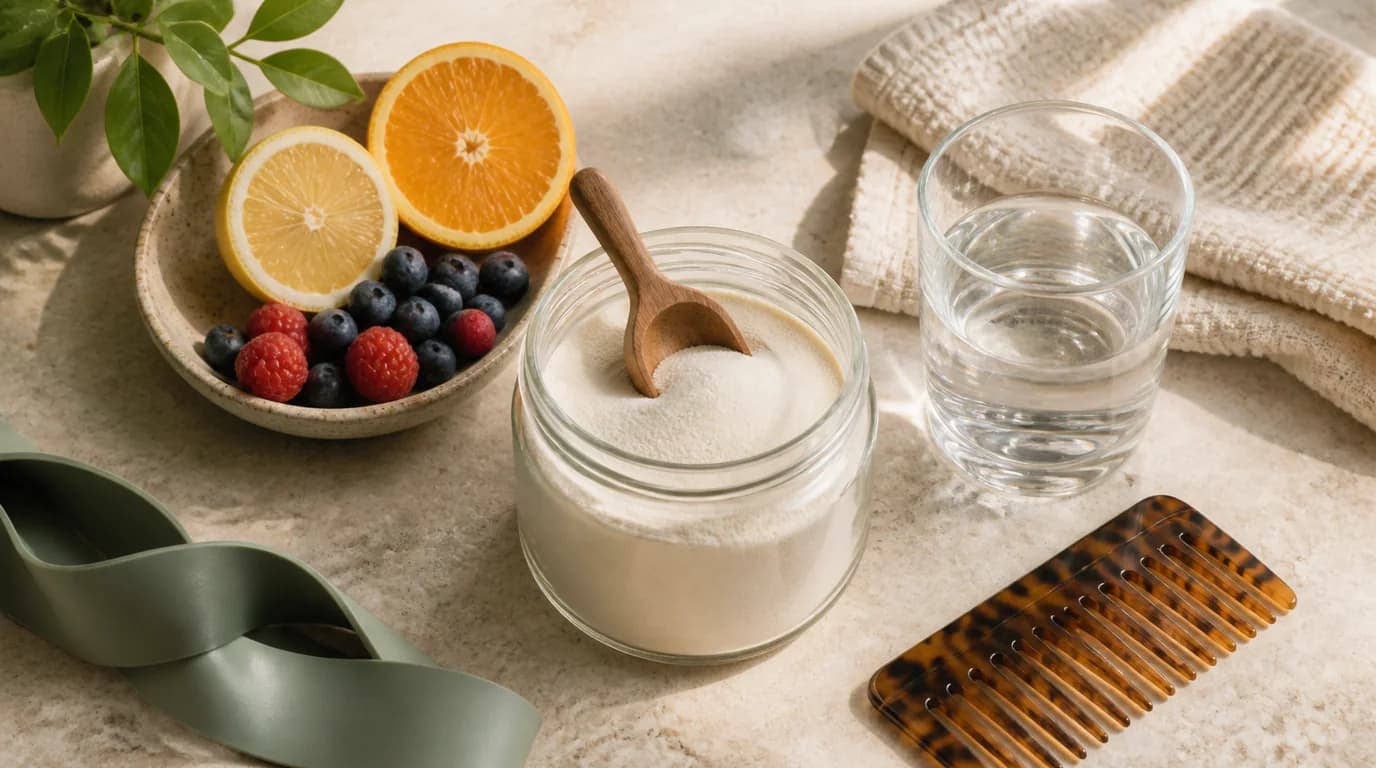
I picked up a collagen tub promising smoother skin, fuller hair and happier knees, which felt suspiciously efficient. My rheumatologist read the front, turned it around and said, “Three claims do not become one body of evidence because they share a label.”
That changed how I shop. Collagen is not nonsense, but the evidence is uneven and depends on the outcome, the formulation and the study. Here is the honest three-part scorecard I wish had been printed on the tub.
The honest collagen check
- ✓What looks promising for skin and joint symptoms
- ✓Why the hair claim is much weaker
- ✓Five label checks before you spend money
A 2023 Nutrients meta-analysis pooled 26 randomized trials with 1,721 participants and found improvements in skin hydration and elasticity with hydrolyzed collagen. Many trials were small or industry-linked, so I read that as promising, not a guarantee for every powder.
The 6-Part Collagen Scorecard
Separate the outcome you want from the promise on the front of the package.
💧 Skin: the strongest beauty signal
Why: Several controlled trials and pooled analyses report modest improvements in hydration or elasticity after oral hydrolyzed collagen. That is a narrower claim than reversing skin aging.
How: If skin is your goal, look for hydrolyzed collagen peptides with a disclosed daily amount. Keep sunscreen, moisturizer, protein and sleep in the plan because the powder does not replace them.
💇♀️ Hair: mostly an unanswered question
Why: Hair contains keratin, not collagen, and large independent trials showing that collagen alone improves hair growth or thickness are missing.
How: Do not use a collagen testimonial to explain new shedding. Ask a clinician about iron, thyroid, medication, stress and hormonal causes instead of assuming the missing ingredient is collagen.
🦵 Joints: promising but formulation-specific
Why: Some randomized trials of hydrolyzed peptides or undenatured type II collagen report less knee pain or better function, but the doses, products and study populations vary.
How: Match the exact type and daily amount on the label to the research behind that product. Do not assume a tiny beauty gummy provides the dose used in a joint trial.
🔎 Read the serving, not the scoop photo
Why: A front label may highlight collagen while the Supplement Facts panel reveals a small amount, several capsules per serving or a proprietary blend.
How: Check grams per full daily serving, servings per container and added ingredients. Calculate the real monthly cost before comparing tubs, sticks, gummies or capsules.
🐟 Check source, allergens and testing
Why: Collagen usually comes from bovine, porcine, marine or chicken sources. The source matters for allergies, dietary preferences and the type of product.
How: Look for a clearly named source, lot testing and independent quality verification. Avoid products that hide the source or stack dozens of unrelated ingredients behind beauty claims.
📓 Run one clean experiment
Why: Starting collagen, biotin, a new moisturizer and a joint routine together makes every result impossible to interpret.
How: Change one thing, take the labeled serving, record the outcome you actually care about and reassess after the study-length window. Stop for a reaction and do not keep buying on hope alone.
My verdict is not “collagen works” or “collagen is a scam.” Skin hydration has the clearest beauty signal, joint data are formulation-specific, and hair claims run ahead of the evidence. Choose one goal before choosing a product.
Supplements are not pre-approved for effectiveness
The FDA does not approve dietary supplements for safety and effectiveness before sale. Check the source for allergies and ask a clinician or pharmacist first if you are pregnant, nursing, preparing for surgery, managing kidney disease or taking medication.
A supplement label cannot tell you whether inflammation, mechanics or stiffness is driving your joint symptoms.
Find your joint fix. Free 60-sec quiz →Start with food before another powder
Get the free 1-page Anti-Inflammatory Grocery List, organized by aisle with practical joint-friendly staples. No spam, unsubscribe anytime.
The Bottom Line
Decide what you are buying collagen for. Skin evidence is encouraging, joint evidence depends on the formulation, and hair evidence is thin. Then read the source, full daily amount and testing information. A specific, trackable goal protects both your expectations and your wallet.
Is a supplement the right next step for your joints?
Take the free 60-second quiz to identify a more practical starting point for your symptom pattern.
Take the free joint quiz →Free · No email required · Results in 60 seconds
Keep reading


Medical disclaimer: This is my personal experience, not medical advice. Talk to a qualified health professional before starting a supplement, especially with allergies, medication or a health condition.