I remember standing in the supplement aisle at Whole Foods, holding a $54 bottle of glucosamine chondroitin in one hand and a $48 bottle of “Advanced Joint Complex” in the other. Both had impressive labels. Neither had a clear explanation of why they would actually work.
I put them both back. Not because I was cheap — I was desperate enough to spend whatever it took. But because I realized I had no idea what I was buying, and I was already taking three things that hadn't moved the needle.
That afternoon, I called my nutritionist friend and said: “Where do I actually start?”Her answer surprised me. “Start in your kitchen. Before you add anything, stop fighting against yourself three times a day.”
Six months later, my morning stiffness had dropped from 20 minutes to under 5. Not from a pill. From five ingredients I now keep in my kitchen without thinking twice — all of them cheaper than one month of any supplement I'd been eyeing.
This article is everything she told me, plus what I've learned since. And at the end, I'll share the $0 tool that — honestly — made as much difference as the food. It's embarrassingly simple and my aunt has been doing it for years.
The research backs this up
A meta-analysis published in Nutrients found that consistent dietary anti-inflammatory patterns reduced joint pain markers by up to 30% in adults over 50 — with no prescription required. [1]
First, Why Does Food Even Matter for Joints?
Here's the simplified version my nutritionist gave me. Joint pain and stiffness are largely driven by chronic low-grade inflammation — your body releasing chemical signals called cytokines that trigger swelling and discomfort. Think of them as alarm signals that your body keeps firing even after the original threat has passed.
After 50, this baseline inflammatory level tends to rise — a process researchers call “inflammaging.” At the same time, your gut absorbs nutrients less efficiently and your antioxidant reserves are lower. The result: your body has less capacity to quiet the alarm on its own.
Anti-inflammatory foods work by providing compounds that directly block or dampen those cytokine signals. They're not magic — but eaten consistently, they shift your body's default inflammatory state downward.
The most important thing I learned:
“Daily consistency beats occasional perfection. One turmeric latte a week does almost nothing. Two cups of berries every morning for three months — that moves the dial.”
The 5 Staples (And Exactly How I Use Them)
🫐 Staple 1: Frozen Mixed Berries
Why it works
Berries — especially blueberries and tart cherries — are loaded with anthocyanins. Think of these as the berry's own defense system against environmental stress. When you eat them, they defend your joints too — blocking some of the same inflammatory enzymes that NSAIDs target, without the side effects.
How I use it
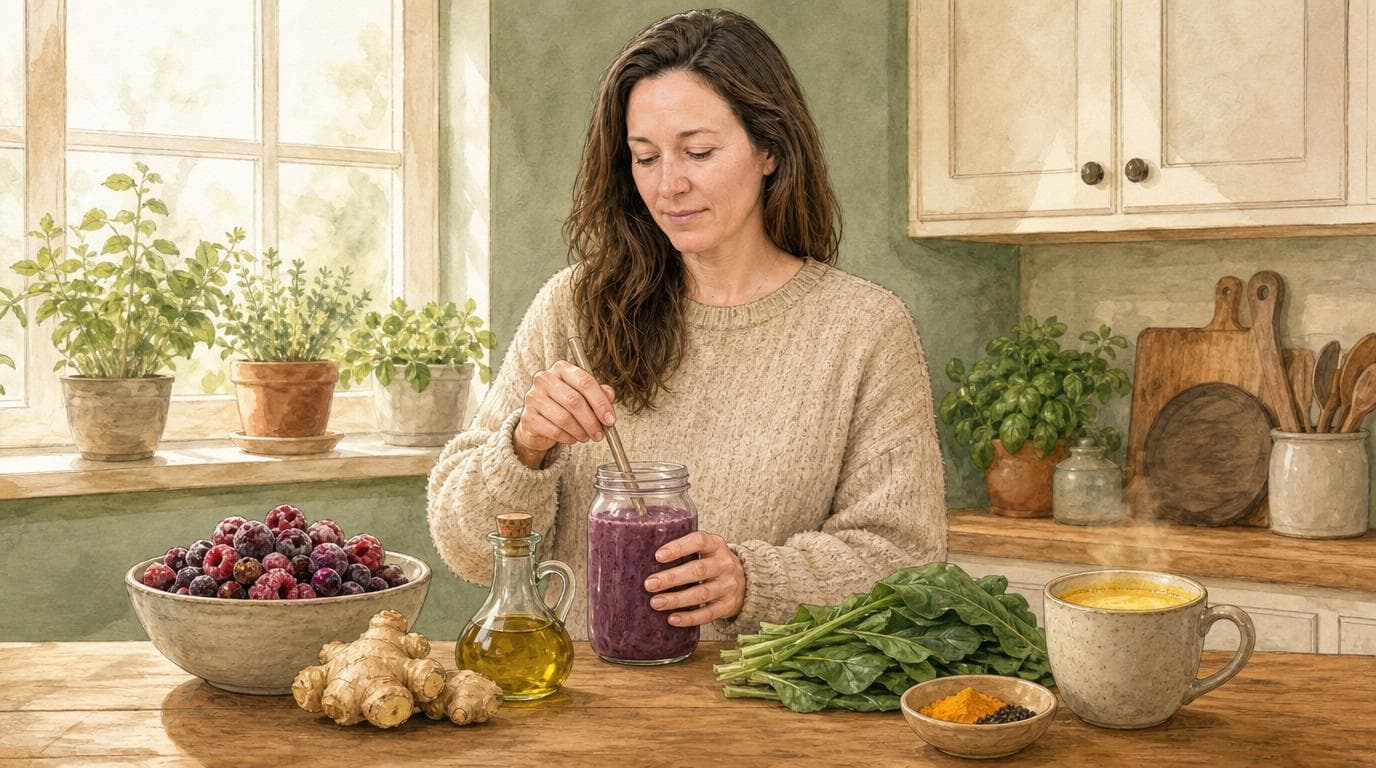
1 cup every morning without exception. Either blended into a smoothie with spinach and oat milk, or thawed overnight and eaten with plain Greek yogurt. Takes 90 seconds either way.
Buying tip
- →Buy organic frozen — cheaper than fresh, higher antioxidant content (frozen at peak ripeness), no waste
- →Look for a mix that includes tart cherries or wild blueberries specifically
- →Avoid anything with added sugar or "flavoring"
🫚 Staple 2: Fresh Ginger Root
Why it works
Fresh ginger contains gingerol— a natural COX-2 inhibitor. That's the same enzyme pathway that ibuprofen targets. A 2013 review in the International Journal of Preventive Medicine found consistent ginger consumption significantly reduced markers of joint inflammation. [2] The keyword is fresh — dried powder has far less gingerol.
How I use it
Morning ginger shot before breakfast, or grated into stir-fry at dinner. I also add a thumbnail-sized piece to my berry smoothie — you barely taste it.
My 2-minute ginger shot
- ·1 inch fresh ginger root (grated or sliced)
- ·Juice of ½ lemon
- ·Pinch of cayenne pepper
- ·2–3 oz warm water
Mix, strain if you prefer, drink immediately.
Buying tip
- →Buy a large knob, peel it, wrap it, and freeze it — lasts 3 months
- →Grate it directly from frozen (easier than fresh, no fibrous strings)
- →Powder is a last resort only — use it if you have no alternative
🫒 Staple 3: Extra Virgin Olive Oil (Cold-Pressed)
Why it works
Good EVOO contains a compound called oleocanthal — the only food molecule known to act like a natural ibuprofen. A landmark 2005 study in Nature confirmed it inhibits the same COX-1 and COX-2 enzymes as anti-inflammatory drugs. [3]The peppery burn you feel in the back of your throat when tasting quality EVOO? That's the oleocanthal.
How I use it
2 tablespoons on salad at lunch (my base dressing is just EVOO + lemon + sea salt). Drizzled on roasted vegetables at dinner. I stopped cooking with it — high heat destroys the oleocanthal. Use avocado oil for cooking instead.
Buying tip
- →Dark glass bottle — light degrades the polyphenols
- →Check for a harvest date (not just "best by") — within 18 months of harvest
- →Taste it: quality EVOO has a distinct peppery, slightly bitter bite
- →Avoid anything labeled "light" or "pure" — these are refined and stripped
🥬 Staple 4: Leafy Greens (Rotation)
Why it works
Dark leafy greens are dense with Vitamin K — essential for regulating calcium in joint tissue — plus a broad antioxidant complex that helps neutralize the free radicals that accelerate joint deterioration. Variety matters here: different greens have different phytonutrient profiles, so rotating them gives you broader coverage.
How I use it
My target is 2 cups daily, spread however it fits: handful in the morning smoothie (you don't taste it), a side salad at lunch, sautéed with garlic at dinner. I rotate spinach, arugula, and kale week by week.
“Confession: I hated kale for a full year. I kept forcing it because it was ‘healthy’ and hating every bite. Arugula was my way in — it has bite and flavor I actually enjoy. Find your gateway green.”
Buying tip
- →Pre-washed baby greens are your best friend — zero prep, grab-and-go
- →Sunday prep ritual: wash a big bunch, spin dry, bag it — ready all week
- →Frozen spinach works fine for smoothies and cooked dishes
🟡 Staple 5: Turmeric + Black Pepper (Always Together)
Why it works
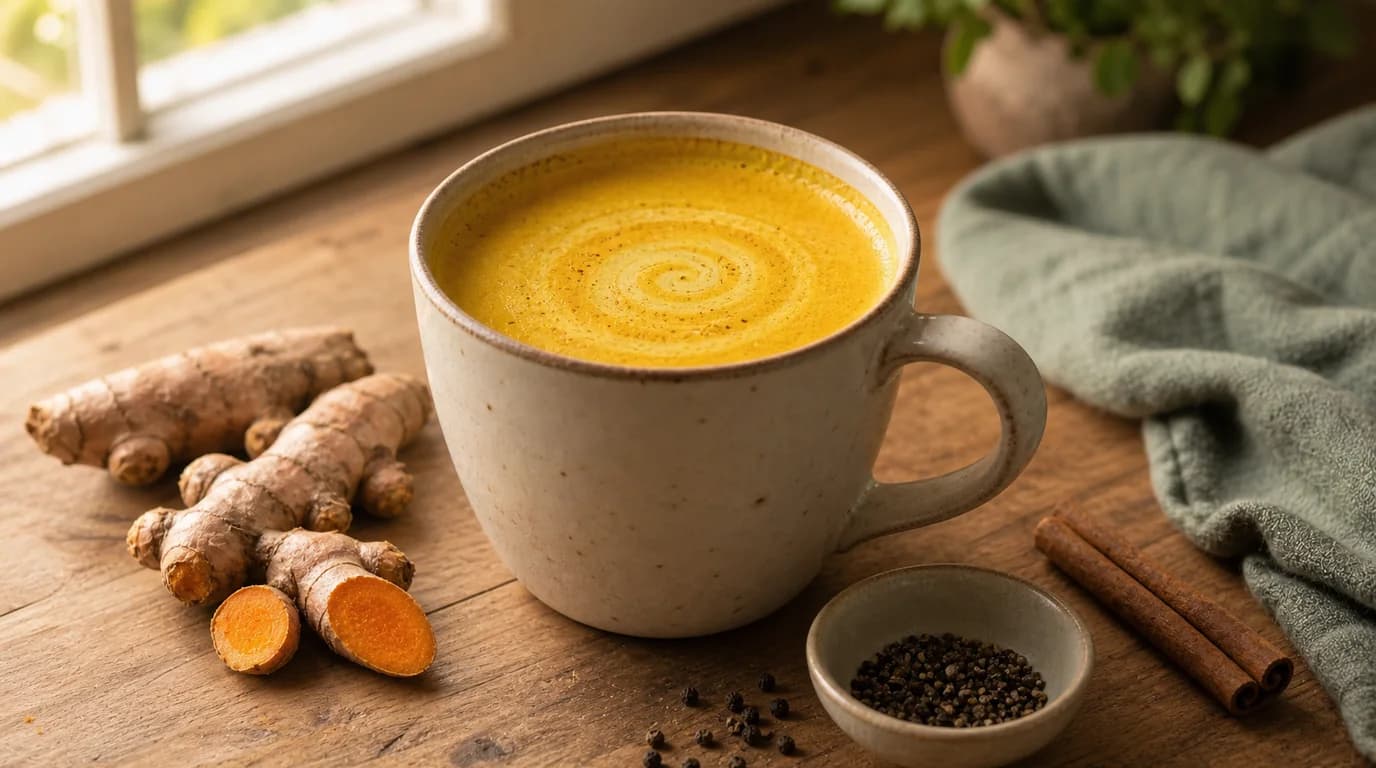
Turmeric's active compound is curcumin — one of the most studied natural anti-inflammatories. The problem is bioavailability: on its own, your body absorbs very little of it. But adding black pepper — which contains piperine — boosts curcumin absorption by up to 2,000%. [4] They must always be used together. Always.
How I use it
My evening golden milk ritual is the main vehicle. I also add a pinch to scrambled eggs in the morning — you barely taste it. Turmeric + black pepper on roasted cauliflower is genuinely delicious.
My evening golden milk
- ·1 tsp turmeric (powder or fresh grated)
- ·Generous pinch of black pepper — non-negotiable
- ·1 cup warm oat milk (or any milk)
- ·½ tsp honey or maple syrup
- ·Optional: pinch of cinnamon
Whisk together, heat gently, sip slowly. This replaced my evening dessert habit within two weeks.
Buying tip
- →Fresh turmeric root (looks like small orange ginger) is more potent — find it in Asian grocery stores
- →If using powder, look for high-curcumin varieties (often labeled "95% curcuminoids")
- →Never use turmeric without black pepper — you're wasting most of the benefit
How to Fit All 5 Into a Normal Day
The good news: these 5 staples layer naturally into meals you're already making. Here's how a typical day looks for me:
Berry + spinach smoothie with a thumb of frozen ginger
Big salad dressed with EVOO, lemon, and sea salt
Stir-fry with ginger, turmeric, black pepper — any protein and veggies
Golden milk instead of dessert or wine
Don't aim for all 5 every single day. Aim for 3. On good weeks you'll hit 5 naturally. On hard weeks, berries in the morning and EVOO at lunch is still a win. Consistency over perfection — always.
“I still eat pizza on Fridays. I had a brownie at my neighbor's birthday last week. These 5 staples aren't about being perfect — they're about building a consistent baseline that your body can actually feel over time. One brownie doesn't undo three months of daily berries.”
— Emma
🧪 Which of these does your body need most?
Every joint profile is different. Take the free 60-second quiz to find out which of these 5 staples your body needs most — and what else might be missing from your routine.
Take the free joint quiz →Free · No email required · Results in 60 seconds
The $0 Tool: Legs Up the Wall (15 Minutes That Changed My Evenings)
My aunt is 71 and has the joint mobility of someone 20 years younger. I asked her secret last Thanksgiving. She walked me to the hallway, lay down on the floor next to the wall, swung her legs vertical, and said: “Every single night. Twenty years.”
I thought she was joking. I tried it that night out of curiosity. Within ten days, the evening knee swelling I'd accepted as normal had visibly reduced. I've done it almost every night since.
Here's the science (simplified): when you spend all day upright, gravity pulls inflammatory fluid and lymphatic waste downward into your lower joints. “Legs Up the Wall” uses gravity in reverse — draining that pooled fluid back toward your core where your lymphatic system can process it. It also gently decompresses the knee and hip joints after a day of bearing weight.
How to do it (exactly)
Place a yoga mat or folded blanket near a clear wall
Sit sideways against the wall, then swing your legs up as you lower your back to the floor
Your legs should be vertical against the wall, lower back flat on the ground
Optional: small folded blanket or pillow under your hips for more comfort
Arms relaxed at your sides, palms up
Breathe slowly and let gravity do the work
Stay 10–15 minutes — this is a great time for a podcast or audiobook
The only time I skip it is when I'm traveling. And I notice the difference within two days — the morning stiffness creeps back up. That told me more about how effective it is than anything else.
What Actually Changed (Honest Timeline)
I want to give you real expectations, not a highlight reel. Here is what my timeline actually looked like:
Noticeably more energy in the mornings. Less brain fog. Not joint-related yet — but motivating.
Morning stiffness dropped from ~20 minutes to ~8 minutes. Evening knee swelling visibly reduced (the Legs Up wall was working).
Morning stiffness under 5 minutes on most days. Stair climbing without pre-bracing. This had quietly become my new normal.
“The shift I didn't expect was mental. I stopped thinking about my joints as something broken that needed fixing. I started thinking about them as something I support every day, the way I brush my teeth. That reframe changed everything — because it made the habits feel normal instead of burdensome.”
— Emma
If you want to understand what's happening inside your joints at a deeper level: why joints feel stiff after 50 and why knees crack every morning — both worth reading alongside this one.

Worth knowing
Food builds the foundation. But therapeutic doses are harder to get from a plate.
After six months of dietary changes, I still felt like something was missing on harder days. The issue isn't that the staples don't work — they do. It's that reaching the curcumin and Boswellia concentrations shown in clinical studies requires more than a daily golden milk. That's what led me to Performance Lab® Flex.
What's in it
- ✓ApresFlex® Boswellia Serrata — fast-acting anti-inflammatory (same tree resin used in Ayurvedic medicine for centuries)
- ✓CurcuWIN® Turmeric — 46× more bioavailable than standard turmeric powder, without needing black pepper
- ✓OptiMSM® — the sulfur compound your connective tissue needs to rebuild collagen
- ✓Glucosamine Sulfate + Phytodroitin™ — joint lubrication and cartilage matrix support
Vegan · Clean label · No synthetic additives · Subscribe & save 25%
See Performance Lab® Flex →Affiliate link — I only recommend products I personally use.
The Bottom Line
You don't need a $200 supplement stack. You need consistency with five foods that work — and one floor exercise that costs nothing.
Berries for anthocyanins. Ginger for gingerol. Olive oil for oleocanthal. Greens for Vitamin K. Turmeric + pepper for curcumin. Legs up the wall for drainage. Every day, imperfectly, for months. That's the whole system.
Want to know which of these your body needs most?
Take the free 60-second quiz. It looks at your specific joint symptoms, age, and history to give you a personalized starting point — no email required.
Take the free joint quiz →Free · No email required · Results in 60 seconds
Frequently Asked Questions
Can I just take turmeric supplements instead of cooking with it?
You can, and for some people high-dose curcumin supplements are a useful addition. But supplements vary enormously in quality and absorption. Cooking with turmeric and black pepper together in fat-containing meals (EVOO is perfect) is a highly bioavailable and consistent way to deliver curcumin daily. If you choose a supplement, look for one that includes piperine or uses a liposomal or phytosome formulation.
How long before I notice joint changes from diet?
Expect 4–8 weeks of consistent daily use before noticing meaningful joint changes. Energy and digestion often improve faster (1–2 weeks). Joint inflammation is slower to shift because it involves systemic changes in your baseline cytokine levels. Don't evaluate results before 6 weeks.
Are frozen berries as good as fresh for anti-inflammatory benefits?
In many cases, frozen berries are actually better. They're frozen at peak ripeness when anthocyanin levels are highest. Fresh berries, especially out of season, are often harvested early and lose nutrients during transport and storage. Organic frozen wild blueberries are my personal top pick.
What if I'm on blood thinners — is Vitamin K in greens a concern?
This is an important question and the answer is: talk to your doctor before significantly increasing leafy green consumption if you take warfarin (Coumadin). Vitamin K affects how warfarin works, and consistency matters more than avoidance — your doctor can help you find a stable intake level. Most other blood thinners (like apixaban) are not affected by Vitamin K, but always confirm with your prescriber.
Can I do Legs Up the Wall if I have high blood pressure?
For mild to moderate, well-controlled high blood pressure, Legs Up the Wall is generally considered safe and may even help by activating the parasympathetic nervous system. However, if your blood pressure is poorly controlled or you have severe hypertension, check with your doctor first. This is not medical advice — always consult your healthcare provider before starting a new physical practice.
Scientific References
- Ricker MA, Haas WC. “Anti-inflammatory diet in clinical practice: a review.” Nutrition in Clinical Practice, 2017.
- Mashhadi NS et al. “Anti-oxidative and anti-inflammatory effects of ginger in health and physical activity: review of current evidence.” International Journal of Preventive Medicine, 2013.
- Beauchamp GK et al. “Phytochemistry: ibuprofen-like activity in extra-virgin olive oil.” Nature, 2005.
- Daily JW et al. “Efficacy of turmeric extracts and curcumin for alleviating the symptoms of joint arthritis: a systematic review and meta-analysis of randomized clinical trials.” Journal of Medicinal Food, 2016.
Medical Disclaimer: This article is for informational purposes only and does not constitute medical advice. It is not intended to diagnose, treat, cure, or prevent any disease. Always consult a qualified healthcare professional before making significant changes to your diet or starting any new physical routine.